

Imagine a boy of twelve who lived in Montesano, Washington in 1942. The Japanese had attacked Pearl Harbor the previous year, and the United States was at war. The boy would have been in the sixth grade. He was smart and he loved school. His name was Eugene and he had two younger sisters, ten and five, and a seven-year-old brother.
His little brother had club feet, had undergone many painful surgeries, and couldn’t walk very well. Gene was protective of him. He made him a cart and wheeled him around in it.
Gene had a hard home life. There were many mouths to feed and not enough money. His father worked in a sawmill and his mother kept their small home. They were a religious family and attended church several times a week, and Gene liked that too.
He just didn’t like being at home. His father was an angry man and often yelled at him and hit him with a switch – and threatened to hit his younger brother.
Gene’s refuge was his school and his church. And then one day when he was twelve he had to choose between them. Gene and his family were Jehovah’s Witnesses and his faith didn’t allow him to pledge allegiance to the flag. It’s considered a form of idolatry and Gene was very clear about the first of the Ten Commandments.
So when the rest of his class stood and pledged allegiance to the flag of the United States of America, Gene remained seated. And then twelve-year-old Gene, who loved school, was expelled.
The next year, the United States Supreme Court ruled that a compulsory flag salute would violate students’ First Amendment rights. The Court said, “If there is any fixed star in our constitutional constellation, it is that no official, high or petty, can prescribe what shall be orthodox in politics, nationalism, religion, or other matters of opinion or force citizens to confess by word or act their faith therein.”
Gene went back to school, but it wasn’t the same, and he was behind. His life at home became much worse and as a teenager he had to live with another family just to survive. He dropped out of high school when he was sixteen and went to work on the railroad repairing section tracks.
And he lost his faith.
Later, he worked hard and got his GED.
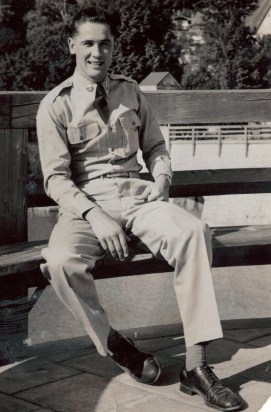
When he was 21, against the pacifist tenets of his former faith, he enlisted in the United States Army. He served honorably, stationed in Germany in the military police, during the Korean War.He was discharged in 1953. Six months later he married my mother.
And my father did not pledge allegiance to our flag, or attend a church, for the rest of his life.

 The Peasley Perspective